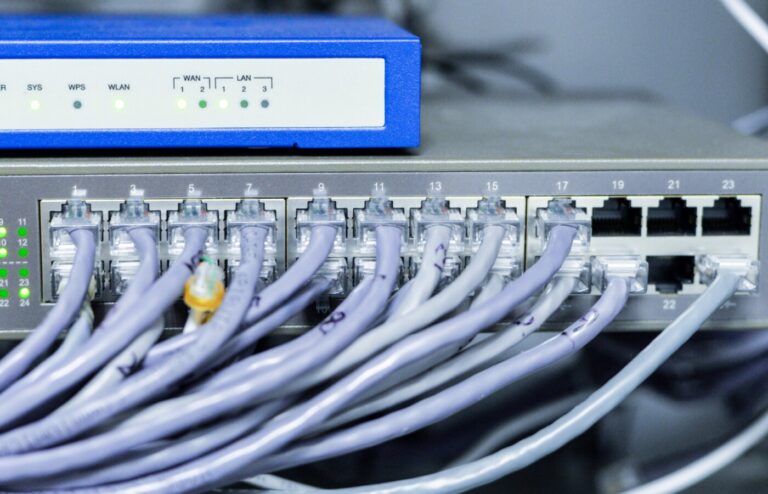
The cabling decision usually arrives late: the lease is signed, the contractor wants the wall layout closed, and somebody asks whether the office should be wired with Cat6, Cat6a or fibre. It deserves a pause, because the cable goes in once and stays behind the drywall for the life of the tenancy, long after the switches plugged into it have been replaced twice.
What separates the three
Cat6 and Cat6a are both twisted pair copper cables terminated on the familiar RJ45 jack. Cat6 is specified to 250 MHz and carries a full gigabit over the standard 100 metre channel, which is 90 metres of permanent link in the wall plus patch cords at each end. It can carry 10 gigabit as well, but only over short runs, and how short depends on how tightly the cables are bundled.
Cat6a is specified to 500 MHz and carries 10 gigabit over the full 100 metre channel. To get there it uses a larger conductor, tighter twists and, in most constructions, a separator or shielding to control alien crosstalk between neighbouring cables. In practice that means a thicker, stiffer cable with a larger bend radius and fewer runs per conduit.
Fibre optic cable carries light rather than electricity. Multimode fibre, usually OM3 or OM4 grades inside a building, handles 10 gigabit over a few hundred metres, and singlemode fibre handles far higher speeds over kilometres. Fibre is immune to electrical interference and takes up very little space. What it does not do is deliver power to the device at the far end, and every fibre link needs optics or a media converter to turn light back into an Ethernet port. Our network cabling and infrastructure work regularly combines all three in one building for exactly those reasons.
Distance is the first filter
Every desk, camera and access point within 90 metres of cable path from a telecom room can be reached on copper. Cable path is the operative phrase: a run that looks like 40 metres on the floor plan often becomes 70 metres once it climbs into the ceiling, follows the corridor and drops into the room. On a large floor, the far corners quietly fall outside copper distance and need either a second telecom room or a fibre link to a small satellite cabinet.
Between floors and between telecom rooms, fibre is the normal backbone. Anything crossing between buildings should be fibre as well, so that a ground potential difference between two electrical services never finds its way into a switch.
Bandwidth today versus bandwidth over the lease
Most desks in a professional office consume a small fraction of a gigabit, and will for years. That argues for Cat6 at the workstation. The counter argument comes from the ceiling. Current wireless access points ship with 2.5 gigabit or faster uplinks, and a busy access point can genuinely exceed a gigabit of client traffic. Cat6 carries 2.5 gigabit over the full channel, but if the office will lean on wireless for a decade, Cat6a to the access point locations removes the question.
The same logic applies to anything that aggregates traffic: a security recorder, a shared server or an uplink to a satellite cabinet. Cable those with Cat6a or fibre and leave Cat6 for individual endpoints.
Power over Ethernet changes the heat picture
An increasing share of what hangs on the network is powered through the cable: cameras, access points, phones, door controllers and displays. Current flowing through copper produces heat, and heat inside a tight bundle raises the temperature of every cable in it. Warmer copper attenuates signal more, which effectively shortens the usable channel.
The larger conductors in Cat6a dissipate that heat better than the smaller conductors common in Cat6, one of the quieter reasons designers favour Cat6a where high-power devices are concentrated. Whatever the category, installation practice matters: smaller bundles, tray rather than tightly cinched ties, and keeping runs out of hot ceiling voids.
Cost drivers, without the numbers
The cable itself is rarely the biggest line. Labour to pull, terminate and test each run dominates, and it is nearly the same for Cat6 or Cat6a. Where Cat6a costs more is in the details around it: bulkier cable needs more pathway, shielded systems need proper bonding, and the connectors and panels cost more. Fibre shifts cost from cable to termination and electronics, since every port needs a transceiver and splicing replaces the quick punch-down of copper.
Building construction sets the rest. An open ceiling with accessible tray is quick; a concrete slab with no ceiling void, plaster walls in an older building, or a warehouse needing lift work all add hours regardless of category. Planning routes early saves more than a cheaper cable ever will. For the equipment room end, our data centre and equipment room cabling page covers how the backbone and patching are organised.
Common questions
Is Cat6a overkill for a small office?
For desks, usually. A small professional office running everyday applications will not push a gigabit per seat for a long time, and Cat6 handles that comfortably. The exceptions are the access point drops and any uplink to a second cabinet, where Cat6a on a handful of runs removes a future constraint. Many small offices land on Cat6 to the desk and Cat6a to the ceiling.
Can existing Cat6 carry 10 gigabit?
Sometimes, over short runs. Cat6 is not rated for 10 gigabit at the full 100 metres, and how far it can actually go depends on how many cables share the bundle and how much crosstalk they induce. A certification tester can measure a specific link and confirm whether it passes at the higher rate. Treat that result as link specific, not a verdict on the whole building.
When does fibre make sense inside a single office?
Fibre earns its place wherever copper distance runs out, wherever a link crosses between electrical services or buildings, and for the backbone between telecom rooms. Within copper distance on a single floor it is rarely needed to the desk, since it cannot power devices and each port needs optics. Many designs run fibre to a satellite cabinet and finish the last stretch in copper.
Does shielded cable perform better than unshielded?
Shielded cable resists external interference and helps control crosstalk, which is why many Cat6a constructions include a foil. It only performs as designed when the shield is bonded correctly at the patch panel and terminated with shielded jacks and cords throughout. A poorly bonded shielded system can behave worse than a good unshielded one, so choose it only where it will be installed properly.
If you are planning a fit-out or refreshing an older office, the right answer is usually a mix, chosen room by room. Talk to us about structured cabling for the space, or get in touch with a floor plan and we will map out what each area actually needs.