A tenant, a customer or an accessibility review has raised the entrance, and the question is not whether to add a power operator but how to do it properly. A barrier-free door operator looks like a small box above the door, yet it touches the door hardware, the access control, the fire alarm and the daily routine of everyone using that entrance. Planning it as a system avoids the two common outcomes: an operator that fights the lock, or one switched off within a year because it kept breaking.
Where operators are expected
The Ontario Building Code contains barrier-free design requirements that, for most building types, call for power door operators at the principal entrance and along the barrier-free path of travel, with the details depending on the occupancy and whether the work is new construction or a renovation. The province’s accessibility legislation adds a broader duty on organisations to remove barriers over time. The practical reading for a building owner is that public entrances, entrances from accessible parking, universal washrooms and doors serving common areas in multi-residential and commercial buildings are the usual candidates. Because the specifics vary with the project, the design should be confirmed against the current code by the architect or the authority having jurisdiction. Our accessible door operator installations are scoped with that check built in.
Low-energy and full-energy operators
Most operators fitted to existing swing doors are low-energy units. They open the door slowly, with limited force, and rely on that gentleness for safety rather than on sensors, which is why they are activated deliberately by a push plate or similar knowing act rather than by simply walking towards the door. They mount on the header, drive an arm attached to the door, and act as the door closer as well, so the existing closer is removed.
Full-energy operators, the kind found on automatic sliding doors and fast-opening swing doors at busy retail entrances, move faster and therefore need presence sensors on both sides, safety zones and guide rails to keep people clear of the moving leaf. They suit high-traffic entrances; low-energy units suit most offices, clinics, condominiums and small businesses.
Activation choices
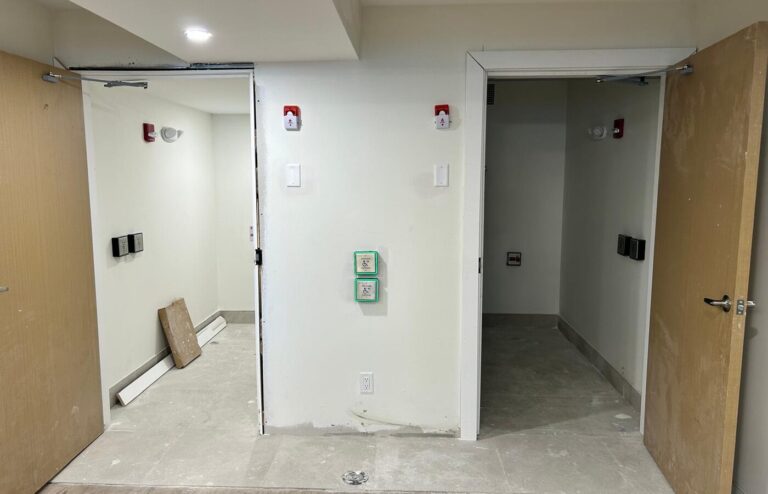
The familiar round push plate remains the default. Placement is what makes it useful: on the wall beside the door at a height a seated user can reach, far enough from the swing that the door does not open into the person who pressed it, and on both sides of the door. Vestibules with two sets of doors need sequenced operators so that the second door opens as the user reaches it rather than both at once.
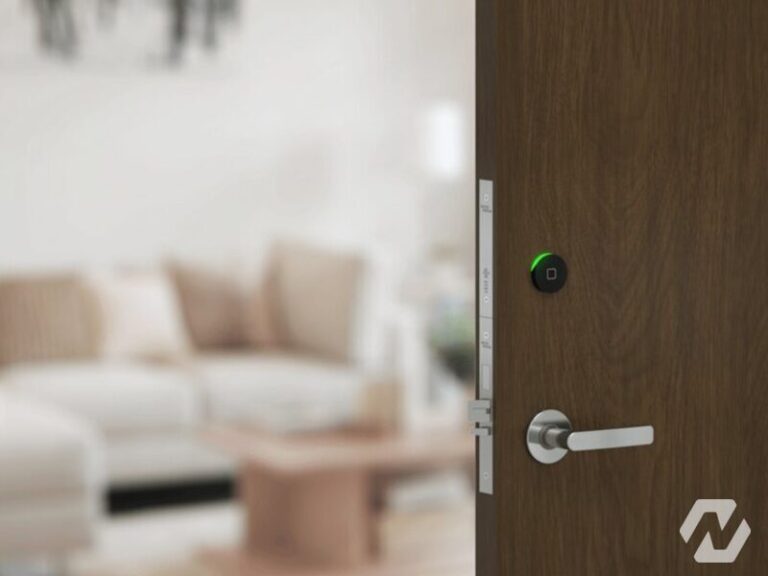
Touchless wave-to-open sensors replace the plate with a short-range sensor that triggers on a hand passing near it, appreciated in healthcare, food service and anywhere hygiene matters. Key fobs and card readers tie the operator into access control: on a locked door, presenting a valid credential both releases the lock and starts the operator, so a resident or employee with limited mobility never has to hold a door while managing a fob.
Locks, access control and fire alarm
The operator must never try to open a locked door. Sequencing is the crucial detail: on activation the controller releases the electric strike or magnetic lock first, waits for it to clear, and only then drives the door. On the egress side, the operator should always allow the door to be pushed open by hand, and any electric lock on an exit must release on fire alarm where the code requires it, so that a power door never becomes a barrier during an evacuation.
Doors in fire separations that are held open by the operator must close on alarm, which means the operator’s hold-open function is wired to the fire alarm relay. Coordinating door hardware, access control and fire alarm is where most operator projects go wrong, and it is why we prefer to handle the operator and the access control together under our door automation work.
Weather, wind and maintenance
Exterior doors in this climate face wind loading, snow at the threshold and temperature swings that thicken lubricants and stiffen weatherstripping. Operators are sized with that in mind, and heavy or wind-exposed doors sometimes need a stronger unit than the door weight alone would suggest. Push plates on the outside should be weather-rated and mounted where snow clearance will not bury them.
An operator is a mechanical device with a motor, an arm and a controller, and it needs the same care as an elevator door: an annual inspection to check opening speed, closing force and hold-open time, plus a look at the arm fixings and the sensors. Manufacturers recommend inspection by a certified technician, and a log of those visits is useful evidence that the building takes accessibility seriously.
Common questions
Which doors in a building need a power operator?
Under the Ontario Building Code’s barrier-free provisions, the principal entrance and doors along the barrier-free path of travel are the usual requirement, with additional doors depending on occupancy, such as universal washrooms and entrances from accessible parking. Renovations and existing buildings are treated differently from new construction. Confirm the specifics for your project with the architect or municipal building department rather than relying on a general rule.
Can an operator be added to an existing door?
Usually, yes. Low-energy operators are designed for retrofit onto existing swing doors, replacing the closer and adding an arm and header unit. The installer will check the door weight, the frame and header condition, clearance for the arm, and whether the door already has an electric lock that must be sequenced with the operator.
What happens to the operator in a power failure?
The door reverts to a manual door. Low-energy operators act as the closer, so the door still closes and can be pushed open by hand. If the door has an electric lock, its behaviour on power loss is set by the lock type: fail-safe locks release, fail-secure locks stay locked, and the choice depends on whether the door is an exit and what the fire code requires. That decision belongs in the design, not the commissioning.
How often should a door operator be serviced?
An annual inspection is the accepted baseline, with a check of opening speed, closing force, hold-open time, sensor operation and mechanical fixings. High-traffic entrances benefit from more frequent visits, and any change to the door hardware, access control or fire alarm should prompt a recheck. A service log demonstrates due diligence and helps catch a failing arm before it fails on someone.
If your building needs to add or upgrade an accessible entrance, we will coordinate the operator with the door hardware, access control and fire alarm so it works as one system. See our barrier-free door operator services, or get in touch and describe the doors involved.