An automatic door is the most used moving machine in any building. Nobody notices it until the day it pushes back, closes early on somebody slow, or stops working in January with the entrance wide open. Knowing how they work is mostly knowing what has to be decided before one goes in.
The three parts of every automatic door
Every automatic door, whatever its style, is an operator, activation, and safety.
The operator is the motor and gearbox that moves the leaf, sized for the door’s weight and the traffic it takes. An operator sized for an internal office door will fail early on a main entrance, not because it was faulty but because it was asked to do a job it was never rated for.
Activation is whatever tells the door to open: a motion sensor over the entrance, a push plate or wave plate, a credential from the access system, or a remote release at a desk.
Safety is what keeps the door from meeting a person: presence sensors watching the threshold and the swing path, holding the door open while anyone is in it and preventing it from starting against them.
The types, and where each belongs
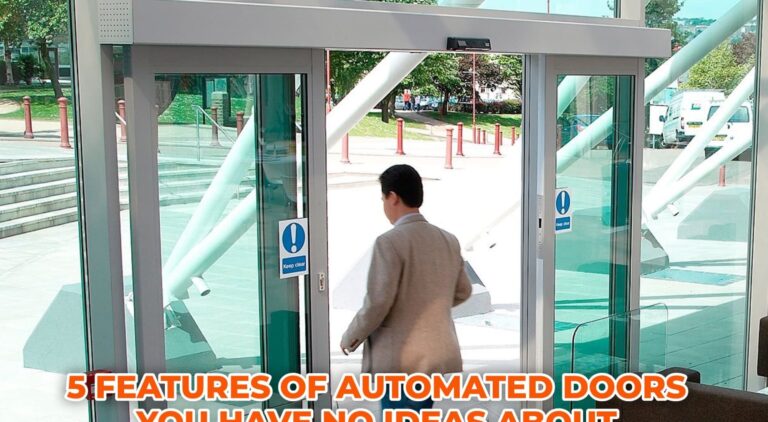
- Sliding doors suit high traffic entrances where people flow both ways at once, and they need clear wall space for the leaves to park
- Swing operators automate an ordinary hinged door, which makes them the workhorse of accessibility upgrades on existing buildings
- Folding doors solve tight vestibules where neither a slider nor a full swing fits
- Revolving doors trade some convenience for a building that loses far less heated and cooled air at a busy entrance
Full power and low energy are different machines
This distinction decides both experience and safety. Full power doors open quickly on sensor activation and rely on their safety sensors to protect people, which suits busy entrances. Low energy operators, the kind behind most accessibility push plates, move slowly and gently enough that the door itself cannot meaningfully harm anyone, and they open on a deliberate action rather than mere approach.
Which one a doorway needs follows from who uses it and how often, and the applicable standards are specific about speeds, forces and timings for each. This is why two doors that look identical can behave completely differently, and both be correct.
Why the advantages are real
Accessibility first: for a person using a wheelchair or a walker, carrying stock, or pushing a delivery cart, the automatic door is the difference between independence and waiting for help. Beyond that, entrances stay closed when unused, which shows up on heating bills. Nobody touches handles, which mattered to hospitals long before it mattered to everyone. And paired with access control, an automatic door lets a secured entrance stay secured while still opening for the people entitled to pass.
What makes one reliable
Almost everything that matters happens at commissioning and after. Opening speed, hold open time and closing force tuned to the doorway and its users, not left at factory defaults. Activation placed so the door is fully open when a person arrives at it. Safety sensors tested with the door in its finished state, weather stripping and all. And then adjustment again after real use, because timings that suited an empty building often need a second pass once the traffic is real.
An automatic door is bought once and used a thousand times a day. The buildings that are happy with theirs are the ones that treated the tuning as the product, not the motor.
That is also why our own door automation work begins at the doorway rather than at the catalogue. We look at the leaf, the frame, the closer and the traffic before choosing between a full power and a low energy operator, we place activation so the door is open when a person reaches it, and we test the safety sensors with the weather stripping fitted and the building at its real temperature. For entrances, washrooms and corridors that need to serve everyone, our accessible door operators are set to the speeds and forces the applicable standards call for and then revisited once the building is in use.
Common questions
Do automatic doors need regular inspection and servicing?
Yes. An automatic door is a moving machine used constantly, and its safety depends on sensors, timings and forces that drift as hardware wears and seasons change. Industry practice is a documented inspection by a trained technician at least once a year, plus simple daily checks by building staff: watch the door open and close, confirm the safety sensors hold it open when someone stands in the path, and report anything that closes early or moves too fast.
Can an existing manual door be made automatic?
Usually, and this is the most common accessibility upgrade in existing buildings. A low energy swing operator mounts on the header of an ordinary hinged door and moves the existing leaf, activated by a push plate or wave plate. The door, hinges and frame need to be in sound condition, power has to be brought to the operator, and any locking hardware must be coordinated so the lock releases, whether on a schedule or by the access system, before the door tries to open.
What happens to an automatic door in a power failure?
Most operators are designed so the door can still be used by hand when power is lost: a swing door pushes open against light resistance and a sliding door has panels that break out for emergency exit. What matters is the locking: any electric lock on the door must be chosen so the exit path remains usable without power, and some sites add battery backup so the operator itself keeps running through a short outage. This is settled at design, not discovered later.
Are automatic doors required for accessibility in Ontario?
The Ontario Building Code’s barrier-free requirements call for power door operators at certain entrances in new construction and significant renovations, and the province’s accessibility legislation sets standards for public spaces. Which specific doors in a given building must have them depends on the occupancy, the work being done and the accessible path of travel, so it is worth confirming with your designer or municipality. Many existing buildings add operators voluntarily because their tenants and visitors need them.
If an entrance in your building pushes back, closes early or simply is not automatic yet, our door automation team can assess it and specify the right operator. Get in touch to arrange a visit.